
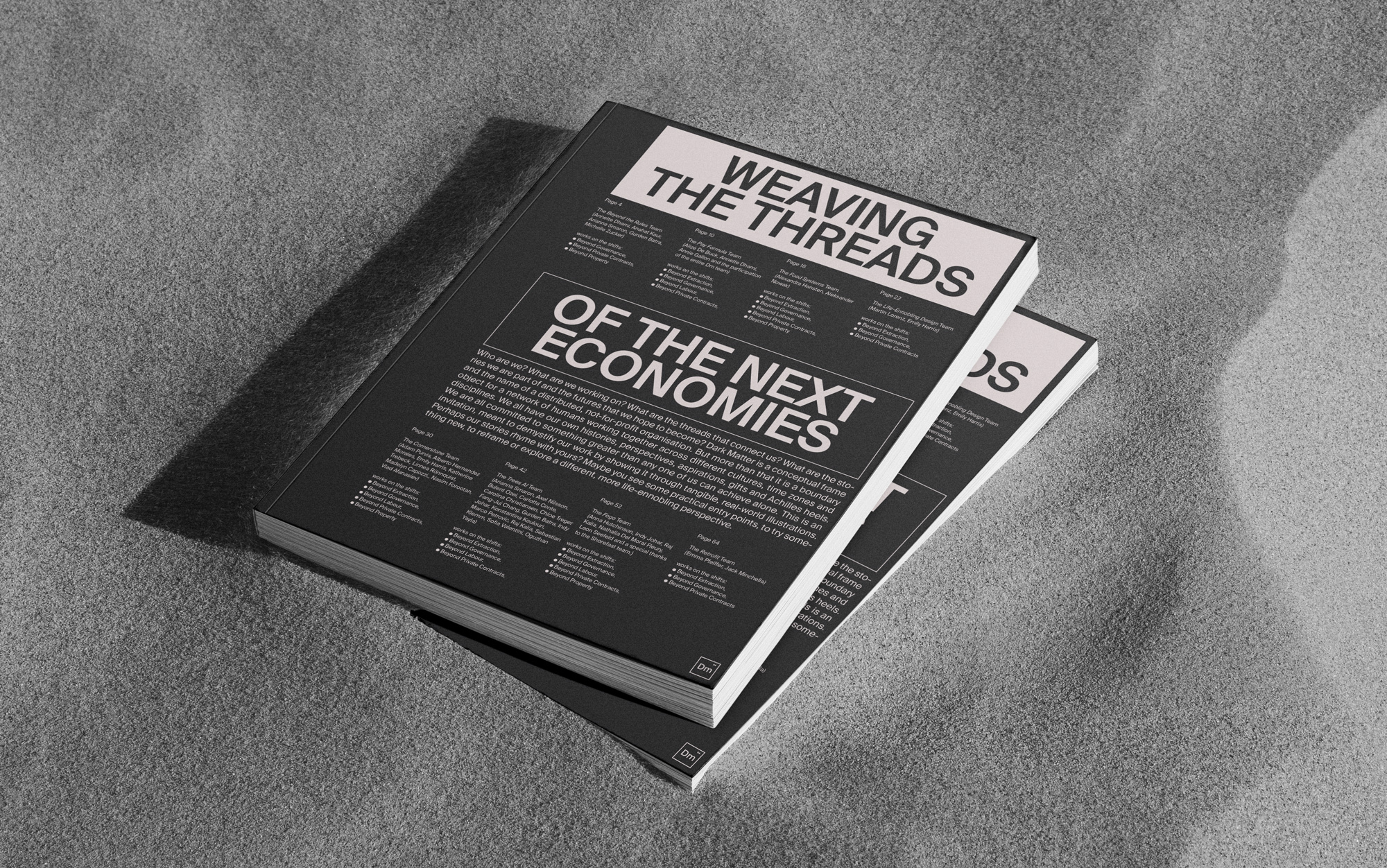
Who are we? What are we working on? What are the threads that connect us? What are the stories we are part of and the futures that we hope to become? Dark Matter is a conceptual frame and the name of a distributed, not-for-profit organisation. But more than that it is a boundary object for a network of humans working together across different cultures, time zones and disciplines. We all have our own histories, perspectives, aspirations, gifts and Achilles heels. We are all committed to something greater than any one of us can achieve alone. This is an invitation, meant to demystify our work by showing it through tangible, real-world illustrations. Perhaps our stories rhyme with yours? Maybe you see some practical entry points, to try something new, to reframe or explore a different, more life-ennobling perspective.
-

Beyond The Rules
“Beyond the Rules” is a specific initiative inside Dark Matter Labs that explores how we can design new forms of governance for complex collaborations, ones that aren’t built around accumulation, ownership and control, but around stewardship, collective agency and emergent alignment.
-

Cornerstone Indicators
There’s a quiet revolution happening in a few communities around the world, a shift in how we value what matters. Supporting this growing ripple of change is a small team at Dark Matter Labs.
-
Fogo Island, Part 1
Shorefast, a community enterprise on Fogo Island, invited Dark Matter Labs to chart the history of discovery, collaboration, and regeneration made possible by those who have invested their time, energy, patience, resources, and financial capital into Fogo Island.
-
Fogo Island, Part 2
Fogo Island (Part 2) What does regenerative economics look like on the ground? A reflective documentary in three parts Part II — The Return of the Tide This is the continuation of the study of Fogo Island as a proof of what regenerative economics looks like on the ground. Part I is accessible here. Zita
-
Fogo Island, Part 3
Fogo Island (Part 3)What does regenerative economics look like on the ground? A reflective documentary in three parts Part III — The Ocean Ahead (Future) Fogo Island today is not a finished story; it’s a living tide. Community businesses reinvest surpluses into programmes and micro-loans that illuminate and regenerate the island’s assets. The past still
-

Food Systems
The most powerful shifts are qualitative at this stage, not quantitative. Individuals and institutions are beginning to see food differently—not just as a commodity, but as a foundation of health, culture, and planetary stability.
-

Life-Ennobling Design
This is a story about design. But actually, it’s a story about us. About how we see, perceive, and reveal ourselves. About language and silence, attention and invitation.
-

Pay Rebalance
Imagine a place where work isn’t something you sell. Where pay doesn’t measure your worth or define your relationship to a structure called “employer.” Where being here, fully, matters more than being right. Where conflict is not a signal of failure but a sign that something alive is trying to move.
-
Retrofitting
Jack Minchella didn’t always think in systems. Trained as an architect in Bath and later Copenhagen, he got bored with buildings that looked nice but solved nothing. “Architecture pretends to solve things like housing affordability, but really… it just decorates the problem,” he told me.
-

Trees AI, Part 1
Trees AI makes nature visible within financial systems. It equips cities to recognize the full value of urban forests.
-
Trees AI, Part 2
This is Part 2 from a short story series. In the first part, we got to know Chloe and Sofia, Dm collaborators, we explored city life and its intricate issues, and we explored the concept of well-being as a central indicator of urban success. In this second part, we get to meet Sebastian, discover the…
What are the threads
that connect us?
Beyond Property
From exerting control over ‘things’ to nurturing the relationships that make our lives possible.
Words like property and ownership are often associated with ideas of dominion and control, allowing us to treat elements of the living world (such as land and rare earth minerals) as objects. Deep down though, do we really believe that timber holds more value than a forest? Or that a whale’s life is interchangeable with a barrel of oil? What would it mean to explore a world beyond property, a world of self sovereign agents who we are respectfully in treaty with?
Beyond Labour
From working to pay the bills to vocations of creativity, purpose and care.
In our industrialised economies humans are often framed as a functional resource. However, rapidly advancing technologies (such as machine automation and alternative distributed currencies) have the potential to weaken the requirement for labour to service financial capital. What would it mean to emancipate the idea of work from its current focus on hierarchy and external incentives? Could we build a future economy that harnesses our inherent, embodied intelligences and unleashes our intrinsic motivations and ability to discover? Perhaps this would be a future of virtuous flow where human satisfaction is rooted in low impact, transcendent goals.
Beyond Extraction
From extracting resources for private gain to taking care of the planetary commons.
Even the word resource is innately extractive and predicated on violence. When we see a sentient animal or element of an ecosystem and name it as a natural resource, we are using language to justify collective violence in pursuit of private comfort. We have become highly proficient at accessing diverse fodder for the global economic supertanker; from the deep sea beds to the depths of the Amazon rainforest nowhere is considered too difficult to access if the price is right. What would happen if we erased ‘resource’ from our active vocabulary, and redirected our ingenuity toward stewarding the global commons?
Beyond Private Contracts
From private agreements that consolidate power to flexible, multi-party commitments to collective thriving.
Many of our existing contracts are structured as bilateral agreements. By design, these agreements ignore the complex interplay of values and the mutual need for care that is integral to most transactions. With the emergence of capabilities such as many-to-many and smart, self-executing contracting, we see an opportunity to revolutionise this root structure of the economy. For example, how would our interactions change if we could easily assemble contracts that recognise relational value? Could we collectively drive a bureaucratic revolution that would create new ways to acknowledge and manage the intricate, entangled flows of value?
Beyond Governance
From centralised decisions and enforcement to institutions of learning and stewardship.
Historically our dominant governance structures have sought to control and instruct. However, with the increasing complexity of both our societal systems and escalating risk pathways, this theory of governance no longer appears viable. From their top-down view, many governments are struggling to intelligently regulate the increasingly complex systems of property that they guarantee.
The most probable directions of future societal travel do not seem appealing. On the one hand we might fail to resolve our global coordination challenges and continue to experience ever intensifying crises (for example, individual countries reopening coal mines to reduce energy costs in the short-term ). Alternatively, we might find ways to overcome perverse incentives but the means to do so will potentially lead us towards authoritarian dystopias. With this in mind, how can we transition away from a centralised model of control, and embrace a governance style that fosters collective learning and empowers the entire system?
Beyond Monetary Capital
From prioritising financial wealth to understanding that real value is multidimensional and often unquantifiable.
What would it mean if we understood capital wealth as an expression of crystallised suffering? Recognising that financial capital is intertwined and enabled by living and social systems could be an important pivot point towards a future rooted in mutually assured thriving. Perhaps then we would feel empowered to reject a monetary system that continues to colonise, exploit and exclude by design. Imagine how our relationship to financial capital might change if we understood the act of investing to be a commitment to our collective futures? What would a system look like where the ways of creating and stewarding money are decentralised and respectful of incommensurate value flows?